
Quantum Computing
Quantum computing represents a fundamental shift in how certain classes of computational problems can be approached — and a corresponding shift in the security assumptions underlying much of today's digital infrastructure. INSTAR's quantum research spans quantum algorithms and their complexity-theoretic foundations, quantum error correction, near-term NISQ-era applications, and quantum-resilient cryptography. We examine both the genuine promise and the honest limitations of quantum approaches, which is the only stance credible to serious researchers and federal program officers alike.

Quantum Algorithms & Complexity
INSTAR examines quantum algorithm design across chemistry simulation, combinatorial optimization, linear algebra, and cryptanalysis — with a sharp focus on distinguishing provable quantum speedups from heuristic claims. Variational quantum eigensolver approaches to molecular electronic structure and quantum approximate optimization for combinatorial problems represent active areas of interest, studied alongside the complexity-theoretic questions that determine whether near-term hardware can actually realize the promised advantage on problems of practical scale.
Error Correction, Security & Near-Term Applications
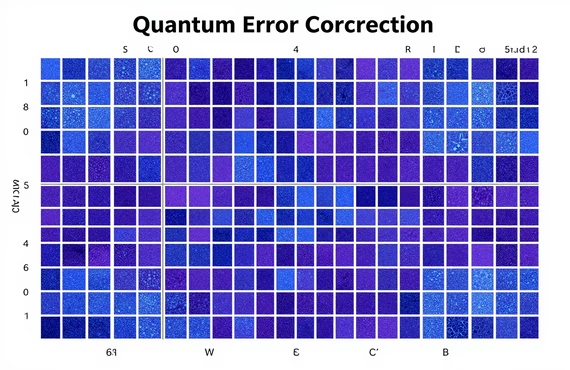
Fault tolerance is the central engineering challenge of practical quantum computing. INSTAR investigates surface codes, topological codes, and related error correction schemes — studying the resource overhead in qubit count, gate fidelity, and connectivity required to execute useful algorithms on realistic hardware. Compilation strategies that minimize that overhead on near-term processors are a complementary research thread.
Equally important is the security dimension: sufficiently capable quantum processors will threaten widely deployed public-key cryptosystems. INSTAR examines post-quantum and quantum-resilient cryptographic approaches as a national-priority research area, alongside analysis of where quantum sensing and simulation may provide near-term scientific value ahead of fault-tolerant computation. PhD researchers in physics, mathematics, and computer science are invited to explore the INSTAR Consortium Postdoctoral Fellowship at /fellowship/.
Grounded in Open Data
INSTAR quantum research draws on open scientific literature, benchmark datasets, and federal technical repositories to maintain rigor and reproducibility.
DOE OSTI
The DOE Office of Scientific and Technical Information provides access to federally funded quantum computing and quantum information science research reports central to INSTAR's literature reviews.
Visit OSTINIST
NIST's post-quantum cryptography standardization effort and quantum information program supply benchmark standards and reference implementations that anchor INSTAR's cryptographic security research.
Visit NISTarXiv
The arXiv quant-ph preprint server is the primary venue for current quantum algorithms and error correction research, and serves as a real-time literature feed for INSTAR's technical teams.
Visit arXivData.gov
U.S. federal datasets from Data.gov support INSTAR's applied quantum research, including government-sponsored benchmark problems and technology readiness assessments for quantum systems.
Visit Data.govOUR PARTNERS






Join the INSTAR Fellowship
Physicists, mathematicians, and computer scientists working on quantum algorithms, error correction, or post-quantum security are invited to apply for the INSTAR Consortium Postdoctoral Fellowship — structured research residency at the frontier of quantum science.