
Formal Methods
INSTAR's formal methods research addresses one of computing's hardest problems: establishing, through mathematical proof rather than empirical testing, that a system does exactly what its specification requires. We investigate theorem proving, model checking, and type-theoretic frameworks as tools for building software and hardware systems where failure is not an acceptable outcome — safety-critical infrastructure, cryptographic protocols, and high-assurance embedded systems.
Theorem Proving & Verification
INSTAR explores interactive theorem proving with tools such as Coq, Lean, and Isabelle alongside automated SMT solvers — examining how mathematical proof can be applied to operating system kernels, cryptographic protocols, and distributed consensus algorithms. A particular research interest is extending verification to domains where correctness arguments have historically been informal: concurrent systems, probabilistic behavior, and software components that incorporate learned models. These are precisely the domains where the gap between "tested" and "verified" carries real consequences for national infrastructure and public safety.
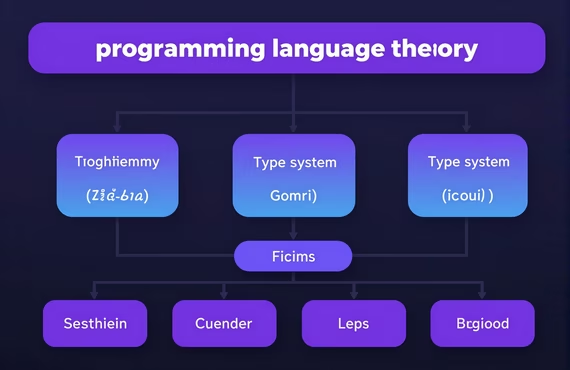
Programming Language Theory & Type Systems
The choice of programming language and type system shapes what classes of error are even expressible — a design decision with long-term consequences for software reliability. INSTAR investigates type-theoretic approaches that encode safety and security constraints as compile-time invariants, abstract interpretation frameworks for static analysis, and the formal semantics foundations — lambda calculus, category theory, denotational semantics — that give language design a rigorous underpinning rather than an empirical one.
This research connects to INSTAR's broader mission across high-assurance computing, AI safety, and quantum software correctness. Early-career researchers with backgrounds in logic, programming languages, or mathematics are encouraged to explore the 12-month INSTAR Consortium Postdoctoral Fellowship at /fellowship/.
Grounded in Open Data
INSTAR's formal methods research draws on open verification benchmarks, published safety case repositories, and federal standards that allow our correctness arguments to be independently checked. Transparency in formal proofs is not optional — it is the point.
NASA Formal Methods
NASA's formal methods group publishes open verification case studies, tool evaluations, and safety analyses that INSTAR uses to calibrate our theorem proving approaches against aerospace-grade correctness requirements.
NASA Formal Methods ProgramNIST
NIST cryptographic standards and post-quantum algorithm specifications provide the correctness targets INSTAR uses to evaluate formal verification coverage of cryptographic implementations.
National Institute of Standards and TechnologySV-COMP Benchmarks
The International Competition on Software Verification provides standardized benchmarks and ground-truth verdicts that INSTAR uses to evaluate model checking tools and compare automated verification approaches.
SV-COMP Software VerificationData.gov
Federal government data catalogs provide real-world system specifications and policy documents that INSTAR uses to develop and test formal specification methodologies for government-adjacent software systems.
Data.govOUR PARTNERS






For Researchers
Join the INSTAR Fellowship
The INSTAR Fellowship is an open citizen-scientist program — no minimum degree required, selection based on fit with our research culture. Structured mentorship, interdisciplinary scope, and the freedom to pursue hard problems.