
ECONOMICS RESEARCH
Economics at INSTAR is less about predicting markets than about understanding how incentive structures, information environments, and institutional arrangements shape human welfare — and how those arrangements can be improved. We apply causal inference methods, agent-based simulation, and behavioral experimentation to questions with direct policy relevance: the economics of innovation, the costs of environmental externalities, the dynamics of inequality. Data science and machine learning have expanded what economic research can ask and answer, and we position ourselves at that frontier.

Computational Economics
We build agent-based models and apply machine learning to simulate complex economic systems, capturing emergent phenomena — market instability, cascading defaults, technology diffusion — that equilibrium frameworks cannot represent. AI tools are changing what computational economics can ask, and we are positioned at that frontier.

Development Economics
We apply causal inference methods — randomized controlled trials, difference-in-differences, regression discontinuity — to evaluate interventions in education, health, and infrastructure. Understanding what actually works, and for whom, is the bedrock of evidence-based development policy with durable public benefit.
Environmental Economics
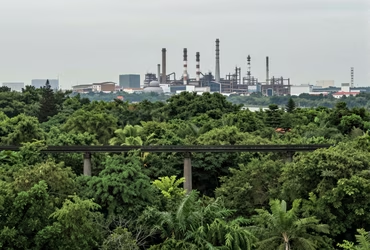
We study the economic dimensions of environmental change — quantifying damage costs, valuing ecosystem services, and analyzing how market-based instruments such as carbon pricing and conservation finance can realign private incentives with public environmental goals. This sits at the productive boundary of economics, ecology, and policy.

Behavioral Economics
Our behavioral economics interest centers on how cognitive biases, social norms, and framing effects shape real decisions — particularly in high-stakes domains like health, financial planning, and technology adoption. This research has direct relevance for public policy design: small structural changes in choice environments can produce large behavioral shifts without mandates or subsidies.

Financial Systems Analysis
We model systemic risk in financial networks, study liquidity dynamics in modern market microstructure, and analyze how monetary policy transmits through the real economy. Financial system stability is a public good; rigorous independent research on its fragilities serves both academic and regulatory purposes.
Innovation Economics
We study the economics of knowledge production and diffusion — how intellectual property regimes, public R&D investment, and knowledge spillovers shape innovation rates and directions across sectors. As an independent nonprofit research institute, INSTAR has a natural stake in understanding what institutional environments let science flourish and translate into societal benefit.
GROUNDED IN OPEN DATA
INSTAR Lab grounds its economics research in transparent, publicly available datasets for reproducibility and public accountability. We draw on the most authoritative federal economic statistics and central bank data to ensure rigorous, policy-relevant analysis.
Bureau of Economic Analysis
National income, GDP, and industry-level economic accounts used in our macroeconomic modeling and policy analysis.
Bureau of Labor Statistics
Employment, wages, inflation, and productivity data central to our labor economics and technology-impact studies.
U.S. Census
Demographic, income, and business survey data providing the population baseline for our economic inequality and market research.
FRED – St. Louis Fed
Extensive macroeconomic time series from the Federal Reserve used in our econometric modeling and forecasting.
data.gov
Federal open-data portal aggregating agency-level economic, financial, and policy datasets for cross-agency analysis.
OUR PARTNERS






For Researchers
Join the INSTAR Fellowship
The INSTAR Fellowship is an open citizen-scientist program — no minimum degree required, selection based on fit with our research culture. Structured mentorship, interdisciplinary scope, and the freedom to pursue hard problems.