
SOCIOLOGY RESEARCH
INSTAR's sociology program studies the structures, institutions, and processes through which societies organize, stratify, and transform — combining rigorous quantitative analysis, ethnographic depth, and computational social science methods applied to large-scale digital and administrative data. Understanding social dynamics at scale is essential for evidence-based policy on inequality, workforce development, and community resilience: all areas of sustained national interest that benefit directly from independent nonprofit research.
Computational Social Science
INSTAR's computational social science research analyzes large-scale digital traces, administrative records, and longitudinal survey data using network analysis, natural language processing, and causal inference methods. Studying social dynamics at population scale — processes invisible to small-sample observation — requires this methodological infrastructure, and it is increasingly enabled by AI-driven data analytics applied through INSTAR's interdisciplinary consortium.

Inequality & Stratification
INSTAR inequality research investigates how race, class, gender, and other axes of social position structure differential access to wealth, education, and labor market opportunity. A core methodological commitment is causal identification: moving beyond description of disparities to understanding the mechanisms that produce and reproduce them — knowledge essential for designing effective policy interventions that serve the American public interest.
Organizations & Institutions
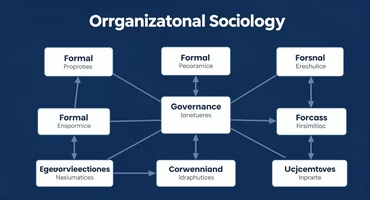
Research on organizations and institutions at INSTAR examines how formal structures, professional networks, and governance arrangements shape collective outcomes across public, private, and nonprofit sectors. Institutional design and the conditions under which bureaucratic organizations adapt or fail to adapt are central questions — with direct relevance to science policy, technology governance, and the effectiveness of public institutions.

Urban Sociology
Urban sociology at INSTAR examines neighborhood change, residential segregation, housing market dynamics, and the spatial concentration of poverty and opportunity using GIS analysis, census data, and ethnographic fieldwork. Cities are where inequality is most legibly inscribed in physical space; rigorous urban research informs housing policy, community investment strategy, and the conditions under which STEM talent pipelines develop and sustain themselves. Early-career sociologists are encouraged to explore the INSTAR Fellowship at /fellowship/.
Grounded in Open Social Data
INSTAR's sociology research draws on the richest publicly accessible social science archives in the world — nationally representative surveys, census records, and harmonized cross-national datasets — to support rigorous, reproducible analyses of social structure and inequality. Open data is the foundation of credible computational social science.
Our primary open sociology sources:
- General Social Survey — flagship U.S. longitudinal survey providing attitudes, behaviors, and demographic data since 1972 for trend and cohort analysis.
- ICPSR — curated archive of social and behavioral science datasets from thousands of studies for secondary analysis and replication.
- IPUMS — harmonized census, survey, and health microdata from the U.S. and internationally for demographic and stratification research.
- U.S. Census — decennial census and American Community Survey data for neighborhood, household, and population-level sociological analysis.
- Data.gov — federal datasets on labor, housing, education, and social policy supporting applied sociological research.
OUR PARTNERS






For Researchers
Join the INSTAR Fellowship
The INSTAR Fellowship is an open citizen-scientist program — no minimum degree required, selection based on fit with our research culture. Structured mentorship, interdisciplinary scope, and the freedom to pursue hard problems.