
Cognitive Sciences Research
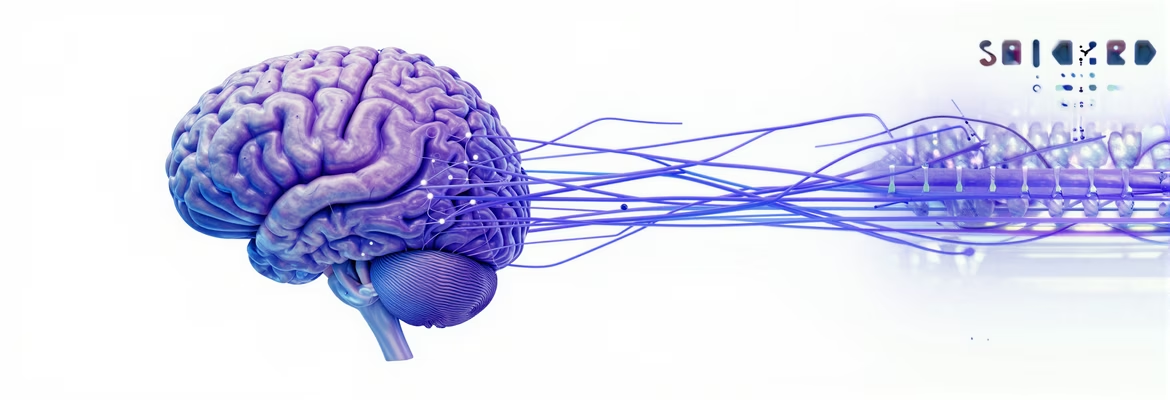
INSTAR's cognitive science program investigates how minds — biological and artificial — represent, process, and act on information. The field is inherently interdisciplinary: rigorous answers to questions about perception, language, reasoning, and learning require simultaneous engagement with psychology, neuroscience, linguistics, philosophy, and AI. That convergence is exactly what INSTAR is built to support, and it makes cognitive science one of our most strategically important research areas at a moment when understanding intelligence has direct national implications.
Perception & Attention
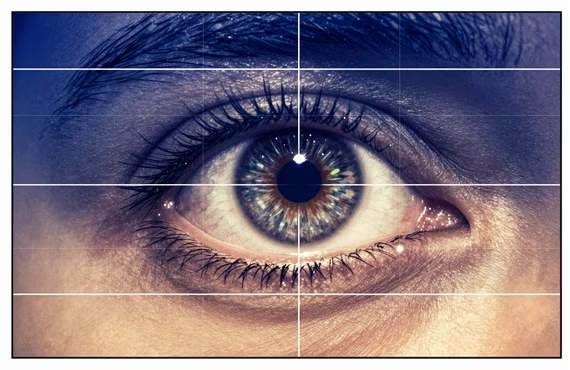
Perception research asks how the brain converts raw sensory data into the stable, actionable representations we call experience. We investigate visual object recognition, auditory scene analysis, and multisensory integration using psychophysics, EEG, fMRI, and computational models drawn from signal processing and machine learning. A recurring theme is how attention and prior knowledge modulate sensory processing — questions that matter for human-machine interface design, clinical assessment of sensory disorders, and the benchmarking of artificial perceptual systems against biological baselines.
Reasoning & Decision-Making
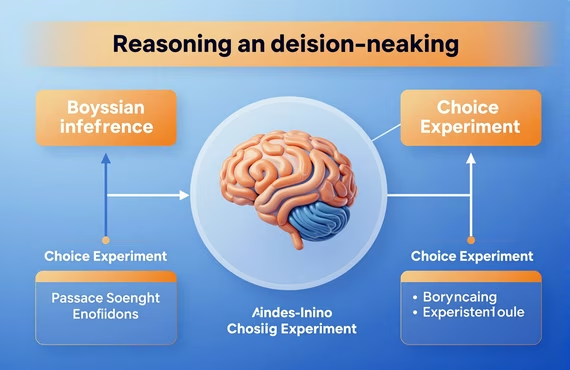
We study how people form causal models, draw analogical inferences, and make choices under uncertainty — and how those processes succeed or fail in systematic ways. Bayesian frameworks and neural network models provide complementary theoretical lenses, one emphasizing rational inference under constraints, the other learned representations from statistical exposure. Understanding where human reasoning departs from normative models has direct relevance for AI alignment: you cannot build systems that reliably assist human judgment without understanding how that judgment works.
INSTAR's cognitive science researchers work in close dialogue with our machine intelligence, neuroscience, and linguistics programs. This convergence is deliberate: the hardest questions about mind span all of these disciplines, and the Fellowship pathway at community/fellowship welcomes postdoctoral scholars who want to work at those intersections.
GROUNDED IN OPEN DATA
INSTAR Lab grounds its cognitive sciences research in transparent, publicly available datasets for reproducibility and public accountability. We leverage open neuroimaging archives and behavioral data repositories to enable rigorous, replicable cognitive research at scale.
OpenNeuro
Open neuroimaging dataset platform used to source fMRI and EEG data for our computational cognitive modeling studies.
NIMH Data Archive
Research domain criteria and clinical neuroscience datasets from NIH supporting our mental health and cognitive disorder research.
ICPSR
Longitudinal behavioral and social science datasets used to ground our cognitive-behavioral and developmental research.
data.gov
Federal open-data portal providing CDC, NIH, and NSF datasets relevant to cognitive health and population-level behavioral studies.
OUR PARTNERS






For Researchers
Join the INSTAR Fellowship
The INSTAR Fellowship is an open citizen-scientist program — no minimum degree required, selection based on fit with our research culture. Structured mentorship, interdisciplinary scope, and the freedom to pursue hard problems.