
COMPUTER SCIENCE
INSTAR's computer science research addresses the foundational problems that determine whether software systems are trustworthy, efficient, and correct. We pursue questions in algorithms, systems architecture, security, and software reliability that matter to federal agencies, critical infrastructure, and scientific computing programs — disciplines where the cost of failure is not a bug report but a breach or a failed mission.
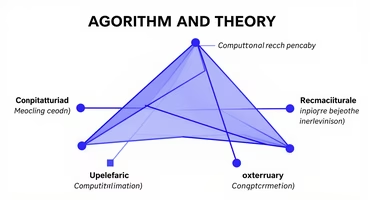
Algorithms & Theory
INSTAR examines computational complexity, approximation algorithms, graph theory, and combinatorial optimization. The emphasis is on provable performance guarantees — understanding not just whether an algorithm works but why, and under what conditions it degrades. This rigor connects directly to applications in scientific computing, large-scale data analysis, and resource-constrained operational environments.
Learn More
Systems & Architecture
INSTAR investigates systems software and hardware architecture questions that shape scientific computing capacity — operating system design, compiler optimization strategies, and the tradeoffs in heterogeneous processor architectures. The research interest is in how systems-level decisions propagate upward into application performance and downward into hardware requirements, particularly for high-performance computational workloads.
Learn More
Computer Security
INSTAR's security research spans cryptographic protocol analysis, program analysis for vulnerability detection, and the formal verification of security properties in software systems. The central question is how to reason rigorously about what a system will not do — a harder and more valuable guarantee than demonstrating what it will do. This work is directly relevant to national cybersecurity priorities and the resilience of critical software infrastructure.
Learn More
Distributed Computing
Distributed computing underpins everything from large-scale scientific simulation to national data infrastructure. INSTAR examines fault-tolerance guarantees, consensus protocol correctness, replication strategies, and workload scheduling in heterogeneous clusters — the layer where theoretical computer science meets the unglamorous reality of hardware failures, network partitions, and resource contention. The INSTAR Fellowship welcomes PhD researchers in CS, mathematics, and related fields; learn more at /fellowship/.
Learn MoreGrounded in Open Data
INSTAR's computer science research relies on open benchmarks, public datasets, and transparent standards to ensure findings are reproducible and peer-verifiable. We draw from federal data resources and community repositories that keep our algorithmic and systems research grounded in real-world conditions.
Data.gov
Federal open data covering government IT, infrastructure, and computational systems — used to benchmark distributed computing and data management algorithms in public-sector contexts.
Data.govNIST
NIST standards and open cryptographic benchmarks inform INSTAR's security research, including post-quantum cryptography evaluation and algorithm correctness testing against published NIST test vectors.
National Institute of Standards and TechnologyUCI ML Repository
The UC Irvine Machine Learning Repository provides canonical algorithm benchmarks used to evaluate complexity and performance of INSTAR's computational methods across diverse problem types.
UCI Machine Learning RepositoryPapers with Code
Open benchmarks and linked code from the research community support reproducible comparison of INSTAR's systems and algorithms against the state of the art across CS research domains.
Papers with CodeOUR PARTNERS






Institutional Partnerships
Become an INSTAR Partner
INSTAR Lab works with universities, government agencies, and enterprises on joint research programs, sponsored projects, and technology transfer. Build science together.