
ARCHAEOLOGY RESEARCH
INSTAR Lab treats archaeology as both a historical science and a data science. We investigate how past human societies adapted to environmental stress, organized complex economies, and built lasting institutions — questions with direct relevance to modern policy challenges. Our approach combines rigorous field methods with remote sensing, geochemical analysis, and machine-learning-assisted classification to extract maximum knowledge from the material record. Preserving and interpreting this record is a public benefit with clear national significance for cultural heritage, education, and STEM workforce development.
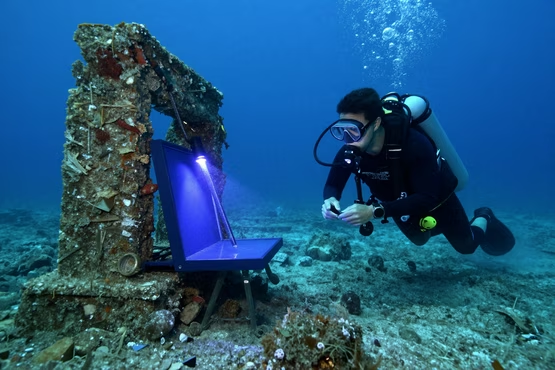
Mediterranean Maritime Survey
Our underwater archaeology team uses side-scan sonar, photogrammetry, and remotely operated vehicles to document submerged harbor installations and shipwreck sites dating from the Bronze Age through the Byzantine period.
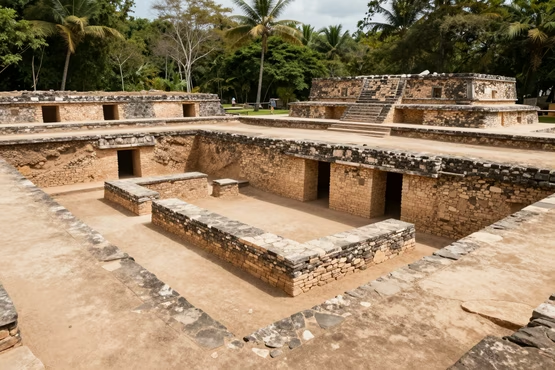
Mesoamerican Settlement Excavation
We excavate residential and ceremonial complexes to investigate urbanization processes, craft specialization, and interregional exchange networks in pre-Columbian Mesoamerica. LiDAR surveys reveal previously unknown site extents.
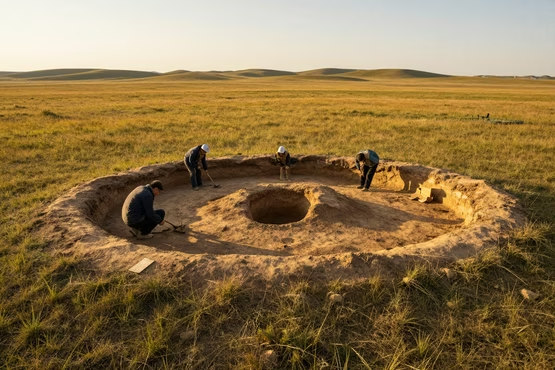
Central Asian Steppe Archaeology
Our team studies pastoral nomadic societies through excavation of burial mounds and habitation sites. Isotopic analysis of human and animal remains traces mobility patterns across the Eurasian steppe.
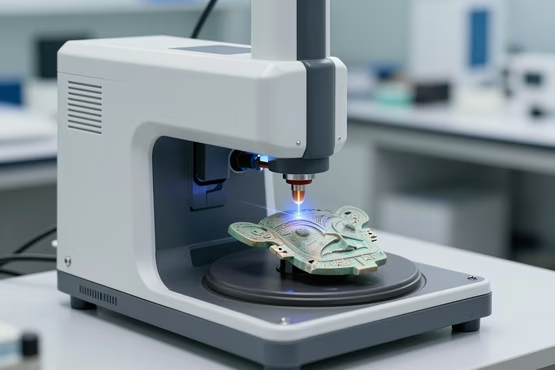
Digital Heritage Documentation
We develop 3D scanning, photogrammetric, and multispectral imaging protocols to create high-fidelity digital records of fragile artifacts and threatened archaeological sites worldwide.
GROUNDED IN OPEN DATA
INSTAR Lab grounds its archaeology research in transparent, publicly available datasets for reproducibility and public accountability. We integrate digital archaeological repositories, open-context data, and federal heritage records to support replicable, peer-verifiable field and computational analyses.
tDAR – The Digital Archaeological Record
Digital archive of archaeological datasets, reports, and gray literature used as primary comparative data for our site analyses.
Open Context
Open-access archaeological data publication platform from which we source artifact assemblage and stratigraphic data.
National Park Service
Cultural resource and heritage site records from NPS used in landscape archaeology and heritage preservation research.
data.gov
Federal portal aggregating geospatial and cultural resource datasets from BLM, USFS, and NPS for our regional surveys.
OUR PARTNERS






For Researchers
Join the INSTAR Fellowship
The INSTAR Fellowship is an open citizen-scientist program — no minimum degree required, selection based on fit with our research culture. Structured mentorship, interdisciplinary scope, and the freedom to pursue hard problems.