
Machine Intelligence
Machine intelligence is simultaneously one of the most consequential and least understood areas of modern computing. INSTAR's research examines how AI and ML systems learn, generalize, and fail — with equal weight given to capability and to safety, reliability, and responsible deployment. Our interdisciplinary approach draws from statistics, cognitive science, mathematics, and domain sciences to ask not only what models can do, but what they should do and when they should not be trusted.
Natural Language Processing & Language Models
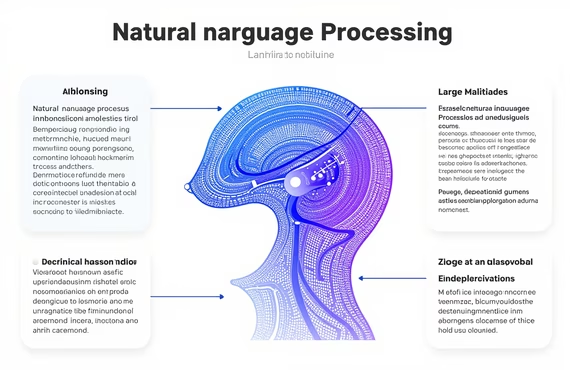
INSTAR examines how large language models represent and manipulate knowledge — and, critically, where they fail to do so reliably. Research interests include retrieval-augmented generation, multilingual understanding, factual grounding, and the evaluation methodologies needed to assess model reliability in high-stakes scientific and operational contexts. The goal is not to chase benchmark performance but to understand what linguistic capability actually means for real applications — scientific synthesis, structured information extraction, and research assistance where errors have downstream consequences.
Computer Vision & Perception
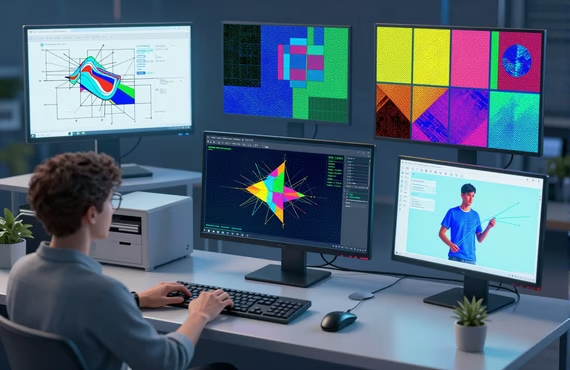
Visual data — medical images, remote sensing imagery, scientific microscopy, and video streams — carries information that is difficult to formalize but essential to act on. INSTAR investigates visual recognition architectures for object detection, semantic segmentation, and 3D scene reconstruction, with emphasis on domains where training data is scarce, labels are expensive, and errors are costly. We are particularly interested in uncertainty-aware perception: systems that can signal when their outputs should not be trusted, which is often more valuable than marginal accuracy gains on standard benchmarks.
Reinforcement Learning & Autonomous Systems
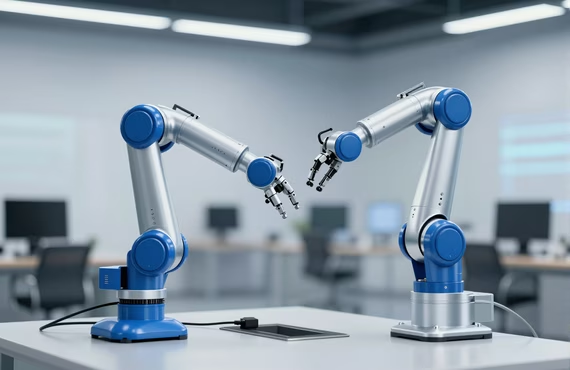
Reinforcement learning offers a principled framework for sequential decision-making under uncertainty, but its practical deployment demands far more than benchmark scores. INSTAR studies sample-efficient learning, safe exploration, and the robustness of learned policies under distribution shift — questions that determine whether RL-derived behavior is suitable for real laboratory automation, resource-management systems, and multi-agent coordination scenarios. The INSTAR Consortium Postdoctoral Fellowship engages early-career researchers from AI, physics, mathematics, and cognitive science; apply at /fellowship/.
Grounded in Open Data
INSTAR's machine intelligence research is anchored in publicly available benchmark datasets and open model evaluation frameworks. Training and evaluating AI systems on open, well-documented datasets ensures our research findings can be scrutinized, reproduced, and built upon by the broader scientific community.
UCI ML Repository
Canonical machine learning benchmark datasets used across INSTAR's statistical learning and ML pipeline research to evaluate algorithm performance under controlled, reproducible conditions.
UCI Machine Learning RepositoryNIST
NIST AI evaluation frameworks and adversarial robustness standards inform INSTAR's trustworthy AI research, providing government-grade benchmarks for safety and reliability assessment of machine learning systems.
National Institute of Standards and TechnologyImageNet
The ImageNet large-scale visual recognition benchmark supports INSTAR's computer vision research, enabling rigorous comparison of perception architectures across a standardized, peer-reviewed evaluation framework.
ImageNet DatasetData.gov
Federal open datasets across health, energy, and infrastructure provide real-world AI application contexts for INSTAR's machine intelligence research, ensuring models are tested against conditions that reflect genuine public-benefit use cases.
Data.govOUR PARTNERS






For Researchers
Join the INSTAR Fellowship
The INSTAR Fellowship is an open citizen-scientist program — no minimum degree required, selection based on fit with our research culture. Structured mentorship, interdisciplinary scope, and the freedom to pursue hard problems.