
Outer Space Research
INSTAR's space science program pursues research across astrophysics, planetary science, and space instrumentation — combining multi-wavelength data analysis, AI-accelerated signal processing, and instrument concept development to advance fundamental understanding of the cosmos. Space science represents one of America's most visible scientific frontiers; INSTAR's independent nonprofit posture enables rigorous inquiry aligned with national space-exploration priorities and the public interest.
Astrophysics & Cosmology
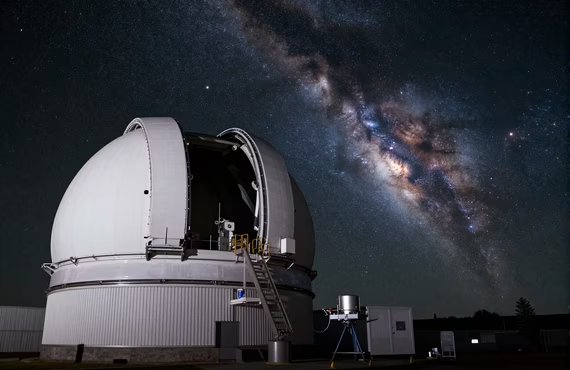
INSTAR astrophysics research examines stellar evolution, galaxy formation, and large-scale cosmic structure using multi-wavelength observations spanning radio through gamma-ray frequencies. Research interests include characterizing exoplanet atmospheres through transit and emission spectroscopy — a field at the frontier of astrobiology and planetary science — and constraining dark matter distributions through weak gravitational lensing analysis. Machine learning applied to large survey datasets is a core methodological emphasis, enabling detection of rare phenomena and statistically rigorous population studies.
Planetary Science
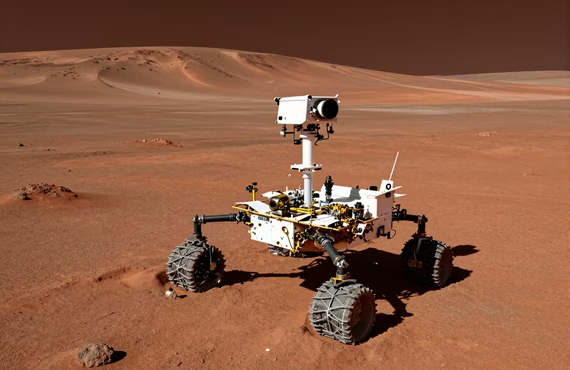
INSTAR planetary science research analyzes surface composition, atmospheric dynamics, and interior geological processes across Solar System bodies, drawing on publicly available data from active space missions. Laboratory-based analysis of meteorite samples and analog materials using mass spectrometry and electron microscopy provides ground-truth for remote sensing interpretations and deepens understanding of planetary formation and habitability conditions relevant to Solar System exploration strategy.
Space Instrumentation
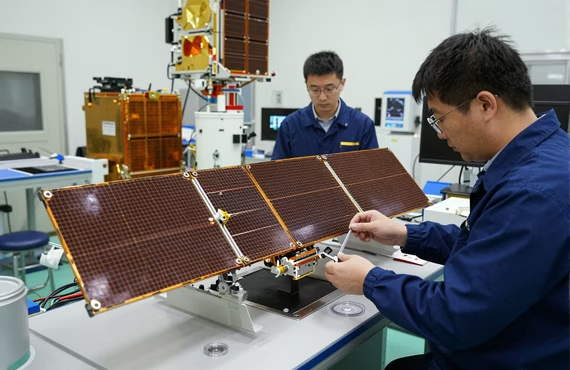
INSTAR's space instrumentation research addresses the design and analytical characterization of scientific payloads for orbital and planetary mission concepts. Research interests include infrared spectroscopy for atmospheric remote sensing and compact sensor arrays relevant to heliophysics — both areas with clear alignment to NASA decadal survey priorities. Researchers interested in space instrumentation are encouraged to explore the INSTAR Fellowship at /fellowship/.
Grounded in Open Space Data
INSTAR's space science program relies on publicly accessible mission data from NASA and USGS to conduct astrophysics, planetary science, and instrumentation research. Open access to telescope observations, planetary surveys, and exoplanet archives ensures that our analyses are transparent and that findings can be reproduced and extended by the global research community.
Our primary open space data sources:
- NASA Open Data Portal — open datasets from NASA missions spanning astrophysics, heliophysics, planetary science, and Earth observation.
- NASA Exoplanet Archive — curated catalog of confirmed exoplanets and transit photometry used for atmospheric characterization and habitability research.
- USGS Astrogeology — planetary maps, digital elevation models, and geologic surveys of Solar System bodies for surface composition analysis.
- Data.gov — federal datasets supporting space policy, heliophysics, and Earth-space system research relevant to national priorities.
OUR PARTNERS






For Researchers
Join the INSTAR Fellowship
The INSTAR Fellowship is an open citizen-scientist program — no minimum degree required, selection based on fit with our research culture. Structured mentorship, interdisciplinary scope, and the freedom to pursue hard problems.