
Physics Research
INSTAR physicists investigate the fundamental laws governing matter, energy, space, and time. Research spans theoretical physics, experimental condensed matter, quantum information science, and applied photonics — probing phenomena from the subatomic to the cosmological. Physics is the bedrock of America's technological competitiveness; INSTAR's independent nonprofit structure enables long-horizon basic research oriented toward public benefit rather than near-term commercial return.
Theoretical Physics
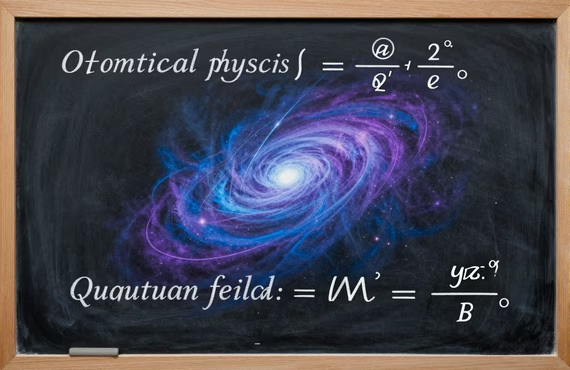
INSTAR theoretical physics research addresses quantum field theory, general relativity, and statistical mechanics, with particular focus on the quantum nature of gravity, topological phases of matter, and non-equilibrium phenomena far from thermodynamic equilibrium. Theoretical work drives experimental programs by generating sharp, falsifiable predictions. The two-way interplay between mathematical framework development and empirical test is the engine of foundational physics — and the source of the unexpected technological breakthroughs that applied programs eventually harvest.
Experimental Physics
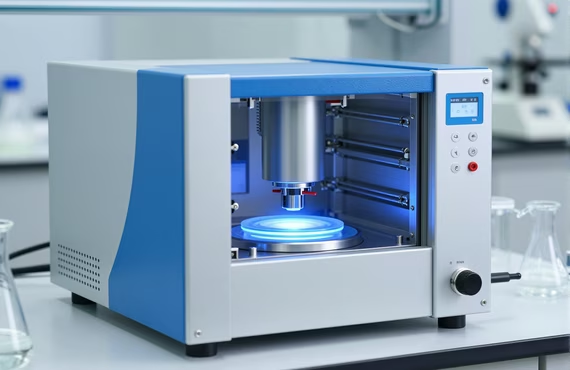
Experimental physics at INSTAR centers on condensed matter systems, ultracold atomic gases, and quantum optical devices. Cryogenic measurement, cleanroom nanofabrication, and ultrafast spectroscopy capabilities enable investigation of superconductivity, topological edge states, and quantum coherence in engineered solid-state platforms. This work sits at the intersection of fundamental quantum physics and the emerging quantum technology sector — an area of sustained national investment and strategic importance.
Applied Physics
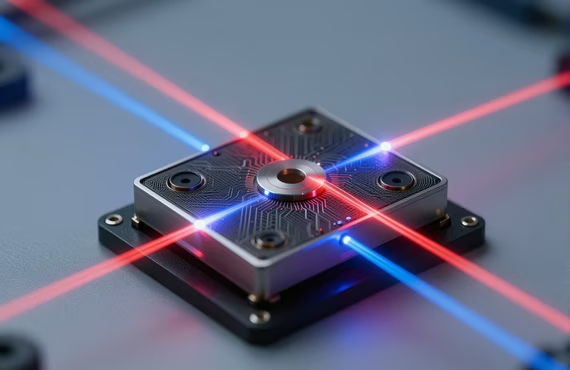
Applied physics at INSTAR translates fundamental advances in photonics, plasmonics, and precision sensing into prototype technologies. Research interests include integrated photonic circuits for secure communications, plasmonic nanostructures for sensitivity-enhanced molecular spectroscopy, and novel detector architectures applicable to medical imaging and environmental monitoring. Researchers in physics are encouraged to apply for the INSTAR Fellowship at /fellowship/.
Grounded in Open Physics Data
INSTAR's physics program uses publicly accessible experimental data, reference values, and preprint repositories to ensure that theoretical predictions and experimental results can be independently verified. Open datasets from major physics collaborations reduce barriers to entry for early-career researchers and strengthen the reproducibility of foundational science.
Our primary open physics sources:
- CERN Open Data — collision datasets and software from CERN experiments (CMS, ATLAS) used for particle physics analysis and machine learning benchmarks.
- NIST Physical Reference Data — authoritative constants, atomic spectra, and cross-section data for calibrating theoretical models and experimental measurements.
- arXiv — open preprint server providing rapid access to current physics literature across condensed matter, quantum physics, and high-energy subfields.
- Data.gov — federal datasets supporting applied physics research in energy, materials, and defense-relevant measurement science.
OUR PARTNERS






For Researchers
Join the INSTAR Fellowship
The INSTAR Fellowship is an open citizen-scientist program — no minimum degree required, selection based on fit with our research culture. Structured mentorship, interdisciplinary scope, and the freedom to pursue hard problems.