
KINESIOLOGY RESEARCH
INSTAR Lab's kinesiology program occupies a distinctive position at the convergence of biomechanics, neuroscience, rehabilitation medicine, and engineering. We study how the human body moves — and how movement breaks down under injury, disease, or aging — using motion capture, electromyography, instrumented surfaces, and musculoskeletal simulation. This research has immediate public health relevance: understanding movement is essential to reducing occupational injury, accelerating rehabilitation, extending independent mobility in aging populations, and improving human performance across the workforce.
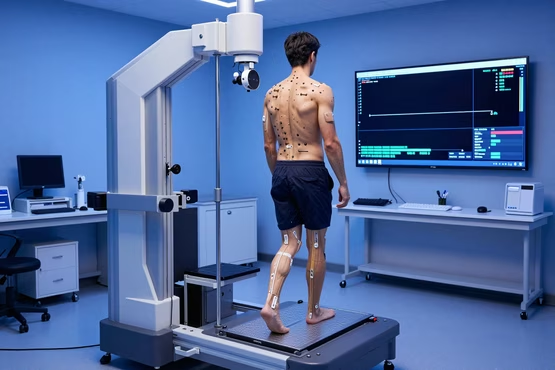
Gait Analysis & Rehabilitation
We investigate walking and running mechanics using instrumented treadmills, inertial measurement units, and subject-specific musculoskeletal simulations. A central aim is translating biomechanical insight into rehabilitation protocols grounded in evidence rather than convention — particularly for recovery from neurological injury, joint replacement, and orthopedic trauma where current standard of care leaves measurable room for improvement.
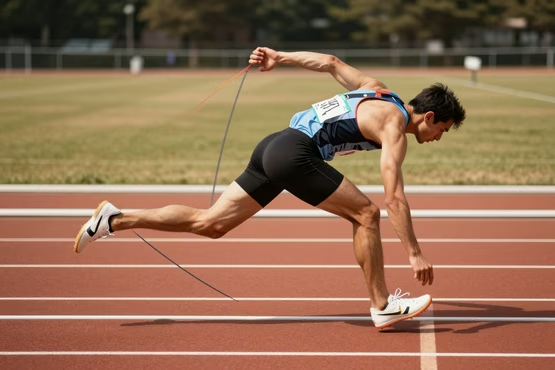
Sports Biomechanics
Sports biomechanics at INSTAR addresses both performance and safety — two goals that are more complementary than they are at odds. We are interested in how movement asymmetries, fatigue patterns, and technique variability relate to overuse injury risk, and in how equipment design choices can protect athletes without compromising the mechanics that drive performance.
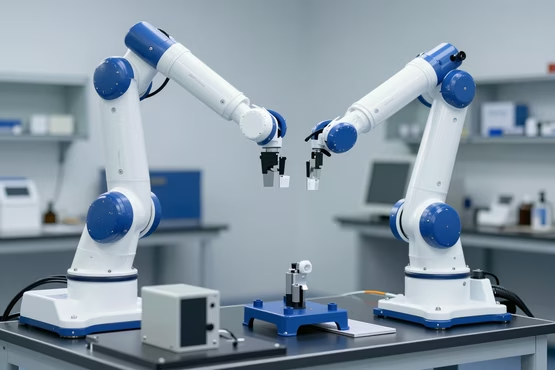
Motor Learning & Control
Motor learning and control research asks how the nervous system acquires, stores, and executes skilled movement — and how that capacity degrades or can be restored after injury or disease. We study sensorimotor adaptation using perturbation paradigms, computational models, and neuroimaging, with downstream implications for stroke rehabilitation and the design of neuroprosthetic interfaces.
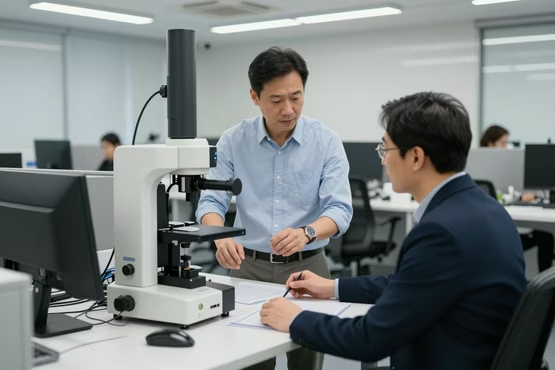
Ergonomics & Human Factors
Musculoskeletal disorders account for a substantial share of occupational disability and lost productivity across the American workforce. We study how task demands, tool geometry, and workstation configuration interact with individual biomechanical capacity — producing design recommendations and intervention strategies grounded in quantitative movement analysis rather than intuition or convention.
GROUNDED IN OPEN DATA
INSTAR Lab grounds its kinesiology research in transparent, publicly available datasets for reproducibility and public accountability. We integrate national health and activity survey data with biomedical research resources to contextualize our biomechanical and movement science findings.
CDC NHANES
National Health and Nutrition Examination Survey data providing physical activity, body composition, and health metrics used in our population-level movement science research.
Bureau of Labor Statistics
Occupational injury, ergonomics, and workforce physical demand data used to ground our workplace kinesiology and rehabilitation research.
NIH
Biomedical research datasets and clinical trial registries from NIH supporting our exercise physiology and rehabilitation science programs.
data.gov
Federal open-data portal providing CDC, NIH, and HHS datasets relevant to physical activity, disability, and population health.
OUR PARTNERS






For Researchers
Join the INSTAR Fellowship
The INSTAR Fellowship is an open citizen-scientist program — no minimum degree required, selection based on fit with our research culture. Structured mentorship, interdisciplinary scope, and the freedom to pursue hard problems.