
CHEMISTRY RESEARCH
Chemistry is the enabling science behind clean energy, advanced materials, pharmaceutical discovery, and environmental remediation — all national priorities in which INSTAR maintains deep research interest. Our chemists work at the boundary between experiment and computation, using quantum mechanical modeling, machine learning potentials, and high-throughput synthesis to move faster and understand deeper than either approach alone. The goal is not just to characterize matter but to design it: new molecules, catalysts, and materials built for purpose from first principles.
Organic Chemistry
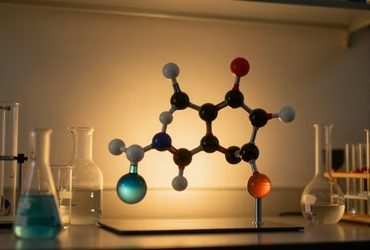
Our synthetic chemistry interest centers on complex molecule construction — natural product analogs, pharmaceutical scaffolds, and functional materials — using both classical and modern catalytic approaches. We are particularly drawn to reaction design problems where selectivity and atom economy are simultaneously at stake, since solving them advances both fundamental methodology and practical applications.
Inorganic & Materials Chemistry
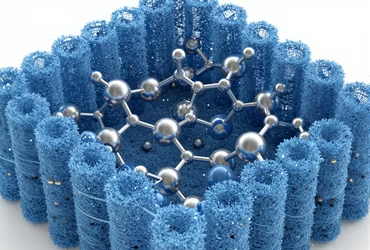
We investigate inorganic compounds, coordination complexes, and nanomaterials with applications in catalysis, energy storage, and chemical sensing. Metal-organic frameworks, single-atom catalysts, and earth-abundant transition-metal complexes are of particular research interest — materials that could reshape chemical manufacturing and energy conversion if their properties can be understood and controlled at the atomic level.
Physical Chemistry
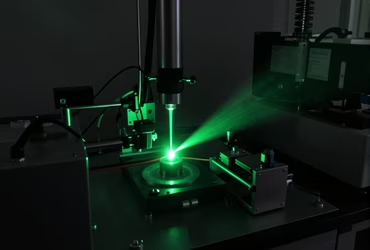
We study reaction kinetics, thermodynamics, and molecular spectroscopy at the intersection of theory and experiment. Ultrafast laser techniques, surface science methods, and quantum chemical calculations let us interrogate energy transfer pathways and catalytic mechanisms at timescales and length scales inaccessible to conventional laboratory observation.
Analytical Chemistry
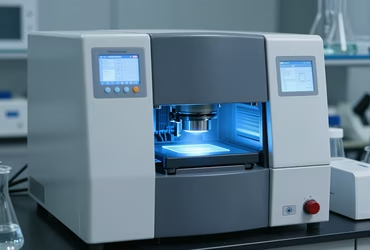
We develop sensitive and selective analytical methods — mass spectrometry, chromatography, electrochemical detection, and optical sensing — capable of identifying and quantifying trace compounds in complex environmental, biological, and industrial matrices. Rigorous measurement underpins every other branch of chemistry; advancing it is never merely technical work.
Computational Chemistry
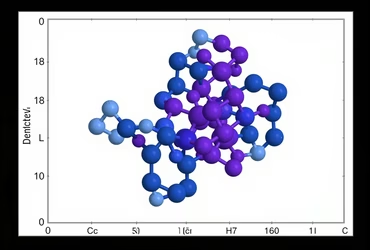
Our computational chemistry work integrates density functional theory, molecular dynamics, and machine-learning interatomic potentials to predict molecular properties, reaction pathways, and phase behavior before a single experiment is run. The result is a tighter feedback loop between theory and the bench — simulations that guide experimental design, and experiments that sharpen models in return.
Green Chemistry
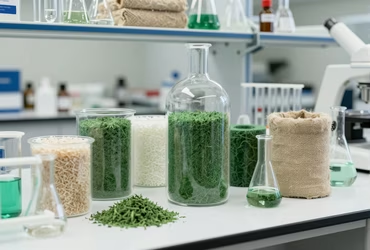
We research chemical processes built from the ground up around waste minimization, benign reagents, and renewable feedstocks. Solvent-free synthesis, biocatalytic routes, and recyclable heterogeneous catalysts all represent directions where scientific rigor and environmental responsibility reinforce rather than constrain each other.
GROUNDED IN OPEN DATA
INSTAR Lab grounds its chemistry research in transparent, publicly available datasets for reproducibility and public accountability. We rely on authoritative chemical property databases and federally maintained reference standards to ensure every computational model and experimental result is independently verifiable.
PubChem
Comprehensive chemical compound database providing molecular structures, properties, and bioassay data for our computational chemistry and drug-discovery research.
NIST Chemistry WebBook
Authoritative physical and chemical property reference data from NIST used to validate our thermodynamic and spectroscopic models.
data.gov
Federal open-data portal providing access to EPA and DOE chemical safety and environmental datasets relevant to our materials research.
OUR PARTNERS





For Researchers
Join the INSTAR Fellowship
The INSTAR Fellowship is an open citizen-scientist program — no minimum degree required, selection based on fit with our research culture. Structured mentorship, interdisciplinary scope, and the freedom to pursue hard problems.