
NEUROSCIENCE RESEARCH
INSTAR's neuroscience program addresses the brain across levels of organization — from ion channels and synapses to large-scale circuits and whole-brain dynamics — using a combination of electrophysiology, optogenetics, advanced imaging, and AI-driven computational modeling. Understanding how neural systems encode information, support memory, and generate adaptive behavior is both a fundamental scientific frontier and a prerequisite for developing effective interventions in neurological and psychiatric disease, areas of clear public-health and national importance.
Systems Neuroscience
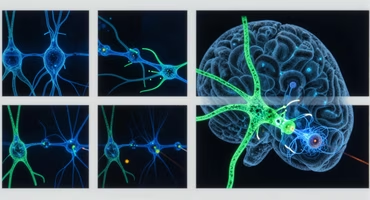
INSTAR's systems neuroscience approach uses multi-electrode arrays and two-photon calcium imaging to record population-level neural activity and decode how distributed circuits encode sensory information, orchestrate motor output, and consolidate memory. Research interests span the neural computations underlying spatial navigation, decision-making under uncertainty, and social cognition — questions with direct relevance to understanding neuropsychiatric vulnerability.
Cellular & Molecular Neuroscience
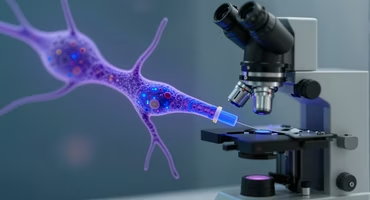
At the cellular level, INSTAR research examines ion channel biophysics, synaptic transmission kinetics, and the intracellular signaling cascades that govern long-term neural plasticity. Patch-clamp electrophysiology, optogenetic circuit dissection, and targeted genetic approaches provide the resolution needed to connect molecular events to circuit-level function — a bridge that is essential for rational therapeutic target identification.
Computational Neuroscience
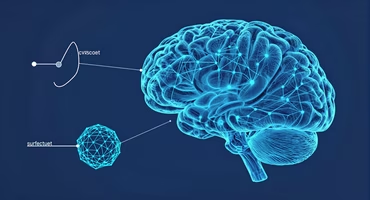
Computational neuroscience at INSTAR uses mathematical models, neural network simulations, and data-driven machine learning to formalize and test hypotheses about how brains compute. Theoretical work on sensory coding, biologically plausible learning rules, and attractor network dynamics generates falsifiable predictions that guide experimental design — and, reciprocally, refines AI architectures by grounding them in biological constraint.
Neuroimaging
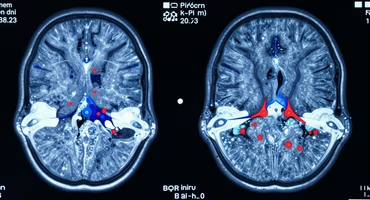
Human neuroimaging research at INSTAR applies MRI, fMRI, MEG, and EEG to study brain function in health and across the spectrum of neurological and psychiatric conditions. We develop novel acquisition sequences and rigorous analysis pipelines — including multivariate pattern classification, dynamic causal modeling, and connectome-based biomarker extraction — that translate raw signal into mechanistic insight. Researchers at any level are encouraged to explore the INSTAR Fellowship at /fellowship/.
Grounded in Open Neuroscience Data
INSTAR's neuroscience research relies on publicly accessible brain imaging, electrophysiology, and connectivity datasets that support reproducible computational modeling and cross-study comparisons. Open neuroimaging data is particularly critical for validating analysis pipelines and ensuring findings generalize beyond single-lab samples.
Our primary open neuroscience sources:
- OpenNeuro — open repository of MRI, MEG, EEG, and iEEG brain imaging datasets for training and benchmarking analysis methods.
- Allen Brain Atlas — gene expression, connectivity, and cell-type atlases for mouse and human brain, used for molecular neuroscience and circuit research.
- NIH BRAIN Initiative — resources, datasets, and tool repositories from the federal initiative advancing neurotechnology and brain circuit mapping.
- Human Connectome Project — high-resolution functional and structural MRI connectivity data for studying whole-brain organization and individual differences.
OUR PARTNERS






For Researchers
Join the INSTAR Fellowship
The INSTAR Fellowship is an open citizen-scientist program — no minimum degree required, selection based on fit with our research culture. Structured mentorship, interdisciplinary scope, and the freedom to pursue hard problems.