
AGRICULTURE RESEARCH
INSTAR Lab's agricultural research addresses one of the most urgent national priorities: maintaining a secure, resilient food supply in a changing climate. We investigate the intersection of agronomic science, soil ecology, and data analytics — applying AI-driven sensing, predictive modeling, and microbial genomics to understand how managed land systems can produce more while degrading less. Our approach is inherently interdisciplinary, drawing on biology, chemistry, economics, and engineering to study problems no single discipline can solve alone.
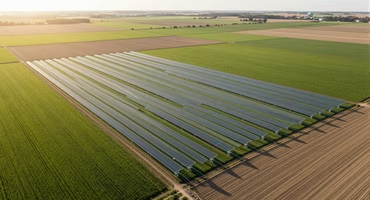
Precision Agriculture
We investigate how sensor networks, drone-based multispectral imaging, and machine learning models can monitor crop health continuously at field scale. The goal is targeted intervention capability — applying the right input at the right place and time rather than broadcasting across entire fields. This kind of precision matters for both yield and input stewardship.
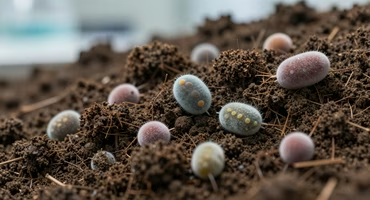
Soil Microbiome Research
We analyze soil microbial communities using metagenomic and metatranscriptomic sequencing to map nutrient cycling pathways and plant-microbe signaling networks. Understanding which microbial consortia drive soil health — and how they respond to tillage, cover cropping, or carbon amendment — is foundational to evidence-based regenerative agriculture.
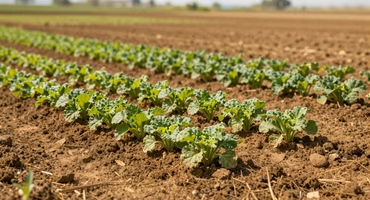
Climate-Resilient Crops
Our research interest in climate-resilient crops sits at the intersection of genetics, agronomy, and climate science. We examine how natural variation and targeted genomic tools can yield varieties better suited to drought, heat, and waterlogging — working across staple and specialty crops to understand the tradeoffs between stress tolerance, yield potential, and nutritional quality.
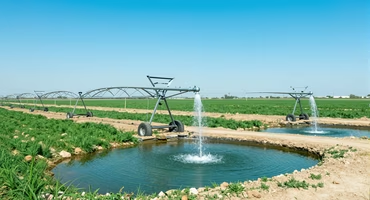
Sustainable Irrigation
Water scarcity is already constraining agricultural output across the American West and globally. We research closed-loop irrigation architectures guided by evapotranspiration models, soil moisture sensing, and weather-coupled decision algorithms — aiming to demonstrate that substantial water savings are achievable without yield sacrifice in arid and semi-arid production systems.
GROUNDED IN OPEN DATA
INSTAR Lab grounds its agricultural research in transparent, publicly available datasets for reproducibility and public accountability. We draw on authoritative federal and international sources spanning production statistics, economic indicators, and global food systems.
USDA NASS Quick Stats
Crop production, acreage, and yield statistics used to calibrate our predictive agronomic models.
USDA ERS
Economic research data on farm income, food prices, and rural demographics informing our food-security analyses.
FAOSTAT
Global food and agriculture statistics from the UN FAO used for cross-country comparative studies.
data.gov
Federal open-data portal aggregating USDA, EPA, and NRCS datasets relevant to land use and water management.
OUR PARTNERS






For Researchers
Join the INSTAR Fellowship
The INSTAR Fellowship is an open citizen-scientist program — no minimum degree required, selection based on fit with our research culture. Structured mentorship, interdisciplinary scope, and the freedom to pursue hard problems.