
BIOLOGY RESEARCH
INSTAR Lab studies living systems across all scales of organization — from the molecular choreography inside a single cell to the population dynamics of ecosystems under pressure. Our biology program spans molecular, cellular, evolutionary, marine, and computational sub-disciplines, united by a conviction that the most consequential discoveries happen when these perspectives converge. AI and data analytics accelerate every facet of this work, from genome assembly to ecological forecasting, making biology one of INSTAR's most richly interdisciplinary research domains.
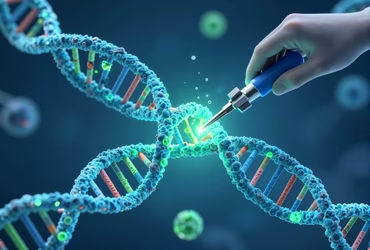
Molecular & Cell Biology
We investigate gene regulation, protein folding, cell signaling, and organelle dynamics using CRISPR-based tools, cryo-electron microscopy, and single-cell sequencing. A core interest is mapping the regulatory networks that govern cell-fate decisions — understanding how the same genome produces hundreds of distinct cell types has profound implications for regenerative medicine and our grasp of disease.
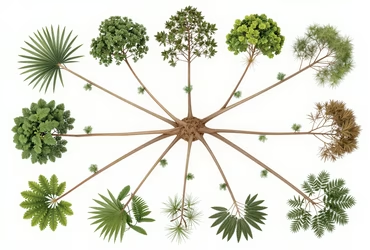
Evolutionary Biology
Our evolutionary biologists reconstruct phylogenetic relationships, study adaptive radiation, and model population genetics using comparative genomic data spanning broad taxonomic ranges. Evolutionary biology grounds our understanding of why organisms work the way they do — the lens through which genetic variation, disease susceptibility, and conservation strategy all make sense.
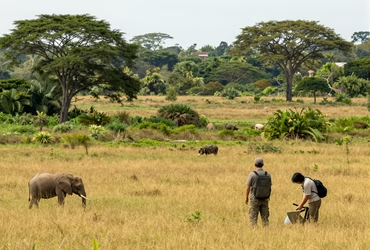
Ecology & Conservation
We study species interactions, community assembly, and ecosystem services through field experiments, satellite remote sensing, and mathematical modeling. Quantifying how ecosystems function — and how they degrade under pressure — is essential knowledge for land management agencies, conservation planners, and anyone designing nature-based climate solutions.
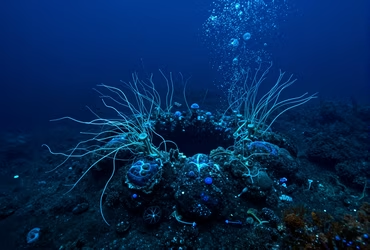
Marine Biology
Our marine biology interest spans coral reef resilience, deep-sea chemosynthetic ecosystems, and pelagic food-web dynamics. The ocean covers most of Earth's surface and regulates climate, oxygen production, and food security — yet remains poorly characterized relative to terrestrial environments. Autonomous platforms and environmental DNA sampling are beginning to change that.
Synthetic Biology
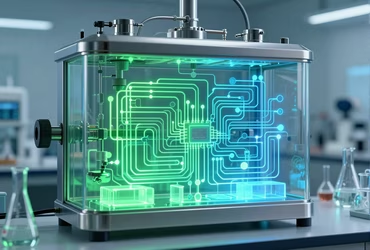
We study the engineering of biological systems — genetic circuits, metabolic pathways, chassis organisms — with interest in biosensing, bioremediation, and bio-based manufacturing. Synthetic biology raises fundamental questions about what is possible with living matter, and answering them rigorously requires the kind of interdisciplinary expertise that sits at INSTAR's core.
Bioinformatics
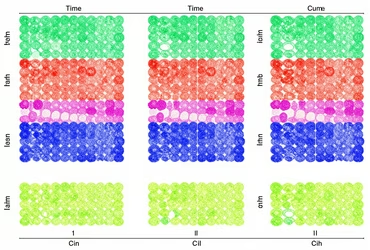
Our computational biologists develop algorithms and analytical pipelines for genome assembly, protein structure prediction, and multi-omics integration. Bioinformatics is not a support function at INSTAR — it is a primary research discipline, generating testable hypotheses about biological systems that no laboratory method alone could surface from the data.
GROUNDED IN OPEN DATA
INSTAR Lab grounds its biology research in transparent, publicly available datasets for reproducibility and public accountability. We build upon foundational genomic, ecological, and biodiversity data repositories maintained by federal agencies and international scientific bodies.
NCBI
Sequence databases, gene expression archives, and PubMed literature used throughout our molecular biology and genomics work.
GBIF
Global Biodiversity Information Facility data underpinning our ecological distribution and species-interaction modeling.
NEON – National Ecological Observatory Network
Continental-scale field observations and remote sensing data for ecosystem and biodiversity research.
data.gov
Federal portal providing access to EPA, USDA, and USGS biological and environmental monitoring datasets.
OUR PARTNERS






For Researchers
Join the INSTAR Fellowship
The INSTAR Fellowship is an open citizen-scientist program — no minimum degree required, selection based on fit with our research culture. Structured mentorship, interdisciplinary scope, and the freedom to pursue hard problems.