
Materials Science Research
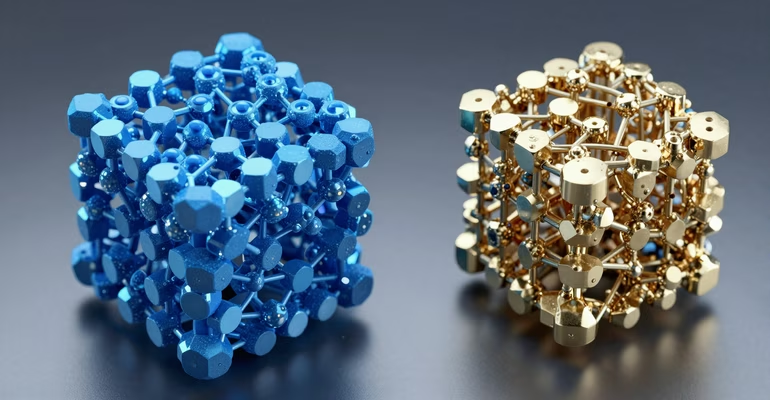
INSTAR's materials science program addresses the foundational challenge of American competitiveness: designing, synthesizing, and characterizing the advanced materials that enable next-generation energy systems, quantum devices, biomedical implants, and defense structures. Our approach integrates experimental synthesis with machine-learning-driven materials discovery, compressing the path from atomic-scale design to functional prototype.
Structural Materials
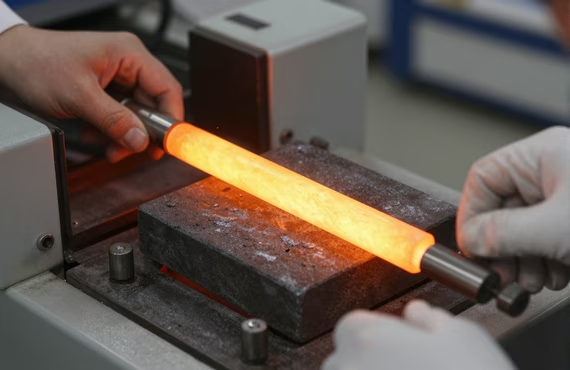
INSTAR pursues the development of high-performance alloys, ceramics, composites, and metamaterials engineered for extreme environments — elevated temperatures, corrosive chemistries, radiation fields, and complex mechanical loading. Our characterization approach spans destructive and non-destructive testing across mechanical, thermal, and chemical property domains. Research interests include lightweight structural alloys for aerospace, radiation-tolerant materials relevant to advanced nuclear energy, and bio-inspired composites capable of autonomous damage response — all areas of recognized national priority.
Functional & Electronic Materials
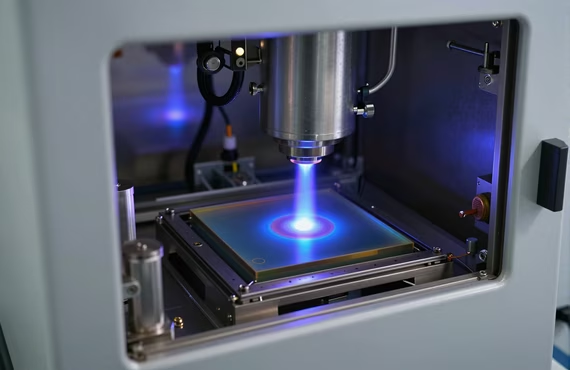
Our functional and electronic materials research targets thin films, nanostructures, and heterostructures with precisely controlled electronic, optical, and magnetic properties. Synthesis techniques of interest include molecular beam epitaxy, chemical vapor deposition, and scalable solution processing for semiconductor devices, topological insulators, and multiferroic systems. Machine learning plays a central role: generative models and high-throughput DFT screening predict stable compositions and optimal synthesis conditions before a single experiment is run.
Structural and compositional analysis at the nanoscale relies on a suite of characterization tools — X-ray diffraction, electron microscopy (SEM/TEM), atomic force microscopy, and optical spectroscopy — enabling rigorous structure-property validation. Researchers in materials science, condensed matter, or related fields are encouraged to explore the INSTAR Fellowship at /fellowship/.
Grounded in Open Materials Data
INSTAR's materials science program relies on publicly accessible computational databases and curated experimental repositories to validate hypotheses, benchmark machine-learning models, and accelerate materials discovery. Open data enables reproducibility across the community and reduces duplicated experimental effort.
Our primary open materials sources:
- Materials Project — high-throughput DFT-computed properties for tens of thousands of materials, used for computational screening and property prediction.
- NIST Materials Data Repository — experimental and computational materials datasets curated to FAIR data standards for benchmarking and validation.
- NIST — reference data on thermophysical, optical, and mechanical properties of materials for calibration and standards-based research.
- Data.gov — federal datasets supporting materials research for defense, energy, and infrastructure applications.
OUR PARTNERS






For Researchers
Join the INSTAR Fellowship
The INSTAR Fellowship is an open citizen-scientist program — no minimum degree required, selection based on fit with our research culture. Structured mentorship, interdisciplinary scope, and the freedom to pursue hard problems.