
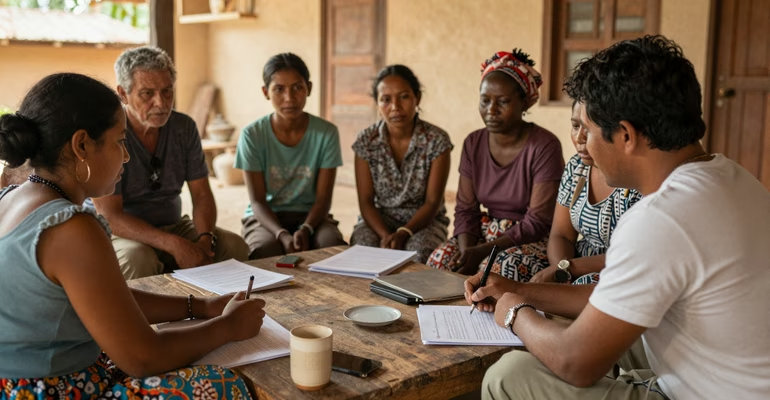
Anthropology Research
INSTAR Lab approaches anthropology as a fundamentally integrative science — one that connects biological, cultural, and computational perspectives to explain how human populations adapt, organize, and endure. Our researchers work across the four subfields, deploying both traditional ethnographic methods and modern analytical tools to study the full arc of human experience. This discipline is especially important to INSTAR's mission: understanding how communities respond to environmental and technological change has direct implications for public health, workforce development, and social cohesion.
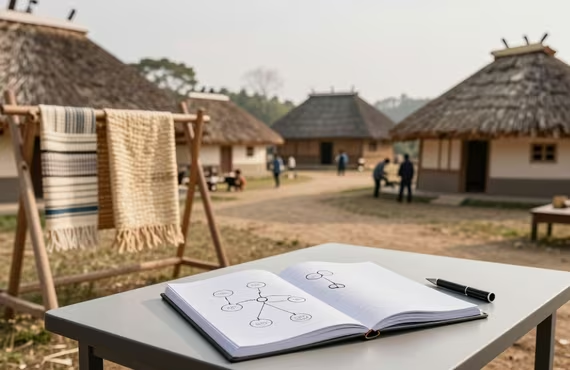
Cultural Anthropology
Cultural anthropology at INSTAR is oriented toward understanding how communities organize knowledge, govern shared resources, and adapt to environmental and technological change. We are particularly interested in how traditional ecological knowledge interacts with scientific data systems — a question that is simultaneously methodological, epistemological, and deeply practical for natural resource management. Our research approach treats community members as intellectual partners, not study subjects, which produces more durable and transferable findings.
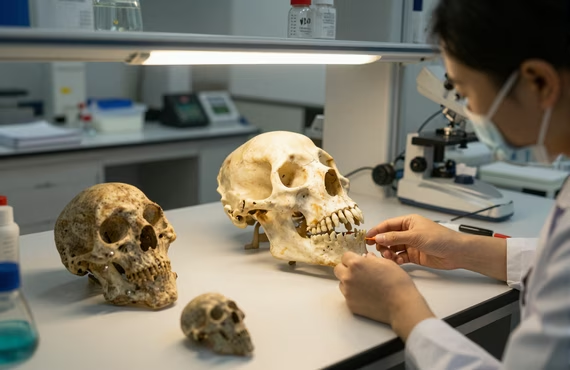
Biological Anthropology
Biological anthropology asks how the human body has changed over evolutionary and historical time — and what those changes reveal about adaptation, migration, diet, and disease. We investigate skeletal morphology, stable isotope signatures, and ancient genomic data to reconstruct population histories and health trajectories across the human lineage. These methods connect directly to modern public health questions, since understanding the evolutionary roots of disease susceptibility has practical clinical implications.
INSTAR's anthropological research program welcomes researchers at every level through the INSTAR Fellowship — an open citizen-scientist program for those who want to develop independent research within an interdisciplinary environment. The breadth of anthropology makes it a natural fit for INSTAR's cross-disciplinary model. Learn more at community/fellowship.
GROUNDED IN OPEN DATA
INSTAR Lab grounds its anthropology research in transparent, publicly available datasets for reproducibility and public accountability. We leverage open archival, cultural, and social science repositories to ensure our findings can be independently verified and built upon.
ICPSR
Social science data archive with thousands of longitudinal studies and surveys used in our behavioral and social analyses.
Smithsonian Open Access
Millions of digitized cultural artifacts and collections data used in our material culture and heritage studies.
NEH
Humanities data and project datasets from the National Endowment for the Humanities supporting our digital humanities work.
data.gov
Federal open-data portal providing demographic, census, and social program data for population and cultural analysis.
OUR PARTNERS





For Researchers
Join the INSTAR Fellowship
The INSTAR Fellowship is an open citizen-scientist program — no minimum degree required, selection based on fit with our research culture. Structured mentorship, interdisciplinary scope, and the freedom to pursue hard problems.