
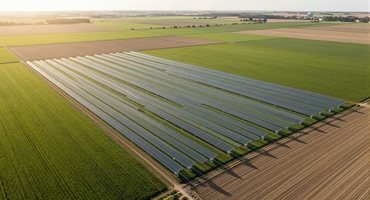
Precision agriculture treats a farm as a set of measurable, manageable subsystems rather than a single undifferentiated field. Sensor networks, remote sensing, and soil microbiome research are giving that idea real analytical teeth—and doing that science credibly depends on grounding every model in agricultural data that other researchers can independently check.
Sensing the field at scale
The core idea behind precision agriculture is simple even though the engineering is not: a field is not uniform, so treating it as if it were wastes water, fertilizer, and yield in roughly equal measure. Ground-based sensors measuring soil moisture, temperature, and electrical conductivity, paired with drone- and satellite-based multispectral imagery, can map variation at a resolution manual scouting cannot match.
The open research problems are less about whether sensors work and more about whether resulting models generalize. A vegetation index calibrated against one crop, one soil type, and one growing season does not necessarily transfer to a different region or year. Ground-truthing remote-sensing signals against actual yield and soil outcomes is the difference between a model that looks impressive in a paper and one a grower can rely on.
Soil microbiome research and the limits of the visible
Below the surface, a parallel program is trying to make sense of what conventional soil chemistry tests cannot see: microbial communities that drive nutrient cycling, disease suppression, and organic-matter formation. Metagenomic and metatranscriptomic sequencing can profile thousands of bacterial and fungal taxa in one soil sample, but the harder question is moving from association to mechanism.
That distinction determines whether a practice such as reduced tillage or cover cropping can be recommended across soils and climates, or whether its apparent benefit was specific to the conditions where it was studied. Long-running field trials that track microbial shifts alongside yield and soil carbon over multiple seasons are the evidence base that turns an appealing narrative into testable science.
Why we ground this work in open agricultural data
INSTAR’s interest in precision agriculture sits inside a broader agriculture program that treats farming as systems science spanning soil chemistry, plant genetics, hydrology, and economics. Sensor networks and microbiome sequencing are useful only to the extent that models built on top of them can be checked, challenged, and reproduced outside the original research team.
That is the same reasoning behind INSTAR’s broader open-data commitment. Sources such as USDA NASS Quick Stats, the USDA Economic Research Service, and FAOSTAT provide long-running, publicly accessible agricultural and food-security data that lets research be judged on its merits rather than taken on faith.