
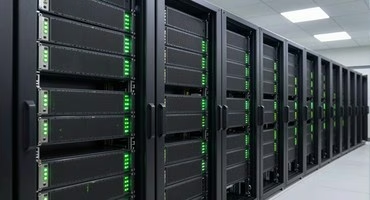
Sovereign Compute: Building Accessible AI Infrastructure
GPU-accelerated clusters and distributed compute are reshaping how researchers train models and run simulations. INSTAR's applied research examines how to bring frontier AI capability onto efficient, controlled, on-premises infrastructure — reducing dependence on large external clouds without sacrificing capability.
The Compute Shift in AI Research
The trajectory of AI capability over the past several years has been inseparable from the trajectory of compute availability. GPU-accelerated clusters have moved from specialized equipment used by a small number of industrial labs into infrastructure that research organizations across many sectors now depend on. Distributed training, large-scale simulation, and inference at scale all require not just powerful processors but the right network topology, storage architecture, and systems software to hold the whole pipeline together. For research organizations without access to hyperscale public cloud budgets, acquiring that capability has historically meant operating at a significant disadvantage.
That constraint is changing, though not because hardware has become cheap. Rather, the software ecosystem for managing AI workloads — scheduling, distributed training frameworks, inference optimization tooling — has matured to the point where well-architected on-premises systems can achieve genuinely competitive performance at a fraction of the sustained operational cost of public cloud equivalents. The architectural choices made in building that infrastructure have become a research problem in their own right.
The Case for Sovereign, On-Premises Infrastructure
The shift toward on-premises and sovereign compute infrastructure is being driven by several converging pressures. Data governance requirements in regulated domains — health, defense, critical infrastructure — often preclude or complicate reliance on third-party cloud providers for sensitive workloads. Researchers working with proprietary datasets, commercially sensitive models, or export-controlled information need compute environments where data residency and access control are unambiguous. In those contexts, sovereign on-premises infrastructure is not an ideological preference but a practical necessity.
Beyond compliance, there is a capability argument. Organizations that understand their own hardware and can tune their software stack to it often achieve efficiency gains that generic cloud configurations cannot match. The tradeoff is that building and operating such systems requires deep expertise across hardware, systems software, and AI workloads simultaneously — a cross-disciplinary integration challenge that sits squarely within applied research rather than straightforward engineering.
INSTAR's Research Into Accessible Frontier AI Capability
INSTAR's applied research in this area centers on the integration problem: how do you stand up and operate an AI-capable compute environment that is efficient, maintainable, and genuinely accessible to researchers without hyperscale resources? The question spans hardware selection and configuration, distributed systems architecture, workload orchestration, and the operational tooling needed to keep complex infrastructure reliable under research workloads that tend to be irregular and bursty by nature.
Our interest is not in building the largest system possible but in understanding the design space well enough to provide serious AI research capability to partner organizations — particularly those in regulated domains or resource-constrained settings where depending solely on large external clouds is not viable. This connects directly to INSTAR's broader mission of making frontier research capability more broadly accessible. Organizations interested in exploring infrastructure partnerships or collaborative research in this area are encouraged to reach out via community/contact or explore our Enterprise R&D programs.
OUR PARTNERS






Support Open Science at INSTAR
INSTAR Lab is a 501(c)(3) nonprofit. Philanthropic gifts fund independent research that no commercial mandate can direct — including applied work in sovereign AI infrastructure and accessible compute. Your contribution is tax-deductible and goes directly to the mission.