

Sovereign AI Laboratory
Air-gapped frontier model training, secure inference, and autonomous reasoning on private infrastructure an organization fully controls. INSTAR's Sovereign AI Laboratory investigates the science of building and operating advanced AI systems entirely within a closed, self-governed environment — eliminating dependence on external cloud providers and giving government, defense, and regulated-industry partners complete authority over their data, their models, and their AI operations.
Why Sovereign AI Matters
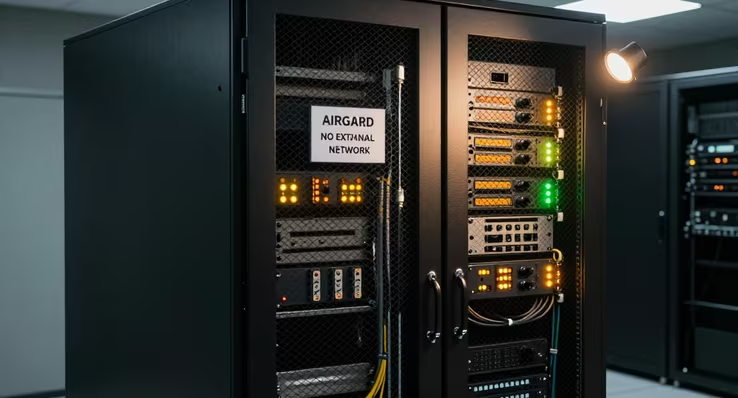
For government agencies, defense contractors, and regulated industries, the act of sending data to an external cloud is itself a risk. Sovereign AI eliminates that exposure by keeping every stage of the AI lifecycle — data curation, training, evaluation, and inference — entirely within infrastructure the organization owns and controls. No third-party visibility. No external API dependency. No vendor lock-in that could be weaponized in an adversarial environment.
INSTAR's research examines the full spectrum of sovereignty requirements: physical air-gap, supply-chain integrity of software and hardware, cryptographic assurance of model provenance, and operational independence that persists even when external networks are unavailable or untrusted. These are not theoretical concerns — they are operational requirements for the sectors we serve.
Frontier Capability on Private Infrastructure
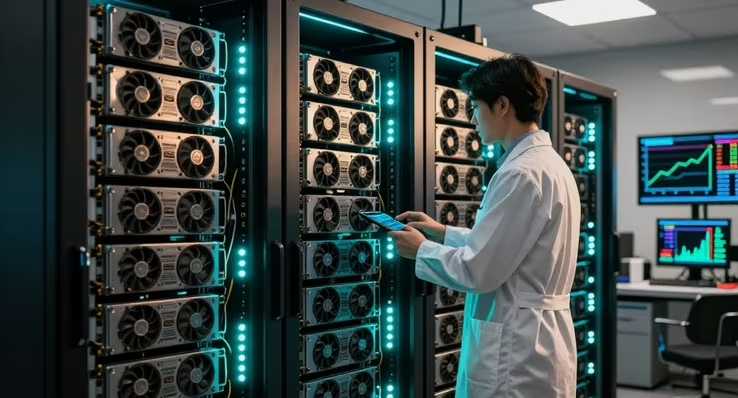
Sovereign operation should not mean accepting a capability ceiling far below what commercial cloud offers. INSTAR researches the science of running frontier-class AI training and inference entirely on privately controlled infrastructure — developing the systems, tooling, and operational practices needed to achieve competitive performance without exposure to external networks.
This research program translates directly into commercial platforms developed and owned by INSTAR's partner companies. Partners who license this research obtain the technical foundation to build and sell on-premises AI inference platforms to customers for whom sovereignty is a non-negotiable requirement. INSTAR's role is the research; commercialization is conducted independently by the partner.
Autonomous Reasoning, Safely
Agentic AI systems — systems that plan, act, and adapt over extended horizons without continuous human direction — represent the leading edge of what AI can do. They also introduce the greatest risks if deployed without rigorous constraint. INSTAR investigates how to build agentic reasoning systems that operate within strict, verifiable guardrails: bounded action spaces, interpretable decision traces, and fail-safe behaviors that hold even under novel or adversarial conditions.
The sovereign AI context is particularly demanding: agents must operate reliably in disconnected environments where no external oversight service is reachable, and where the consequences of unbounded action can be severe. INSTAR's research aims to make safe autonomy a property that can be formally characterized and operationally verified, not merely asserted.
Grounded in Open Data
INSTAR's Sovereign AI research is grounded in publicly available datasets and standards to ensure transparency and reproducibility. We draw on open government data to benchmark secure inference pipelines, validate training workflows, and establish performance baselines that others can independently verify — a practice we consider inseparable from scientific integrity.
- data.gov — U.S. federal open data repository; used to source public datasets for model evaluation and stress-testing sovereign inference systems.
- NIST (National Institute of Standards and Technology) — standards and guidelines for AI security and cryptographic provenance; directly informs our supply-chain integrity research.
- DOE OSTI (Office of Scientific and Technical Information) — Department of Energy open scientific literature; used to benchmark computational requirements for sovereign HPC configurations.
OUR PARTNERS






For Researchers
Join the INSTAR Fellowship
The INSTAR Fellowship is an open citizen-scientist program — no minimum degree required, selection based on fit with our research culture. Structured mentorship, interdisciplinary scope, and the freedom to pursue hard problems.