

Cognitive AI & Persona Systems
Psycholinguistic modeling, personality architectures, and AI personification through inference shaping. INSTAR's Cognitive AI laboratory investigates how artificial intelligence systems can develop and maintain consistent character — communicating coherently and predictably across diverse contexts, aligning with the linguistic and psychological expectations of the humans they work alongside, and sustaining that alignment autonomously rather than degrading over extended interaction.
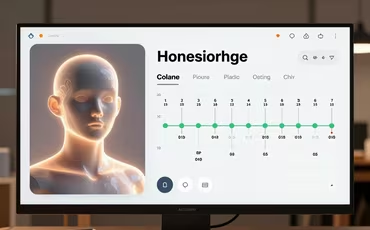
Toward AI with Consistent Character
AI systems that communicate with inconsistent tone, shifting persona, or unpredictable register erode user trust and reduce utility — particularly in long-running relationships where the user has formed expectations about how the system will behave. INSTAR researches the science of stable personality architectures: the underlying structures that allow an AI system to present a coherent, recognizable character regardless of topic, context, or the elapsed time since a persona was established.
This is not merely a user-experience concern. In high-stakes human-AI collaboration — clinical support, education, crisis response, sensitive decision assistance — an AI that behaves predictably and characterologically coherently is also a safer system. Research into persona stability is therefore simultaneously research into reliability and trustworthiness in deployed AI.
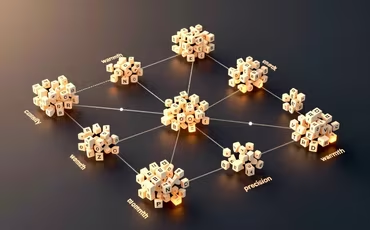
Psycholinguistic Modeling
Language is not simply information transfer — it is the medium through which personality, intent, confidence, and relationship are communicated. Psycholinguistics studies how humans produce and understand language as a cognitive act. INSTAR applies this discipline to AI: investigating how the language choices an AI system makes during generation shape the psychological experience of the human receiving them, and how those choices can be systematically guided to align with the communication goals, expectations, and comfort of a given audience.
This includes research into register adaptation, hedging and certainty signaling, narrative coherence across long exchanges, and the linguistic markers that signal trustworthiness, warmth, or competence — with the goal of giving AI systems the capacity to modulate these dimensions in service of genuine human benefit rather than superficial mimicry.

Human-Aligned, Agentic Systems
Agentic AI — systems that pursue goals over extended horizons with significant autonomy — are only as valuable as their ability to remain aligned with human intent throughout their operation. INSTAR's cognitive AI research directly addresses this challenge: stable persona architectures and psycholinguistic grounding are not just features for interactive chatbots, they are foundational properties that make agentic systems legible, predictable, and correctable by the humans overseeing them.
Practical applications of this research span education (AI tutors that adapt to a student's learning state and maintain motivating relationships over months), personal assistance (agents that develop genuine familiarity with a user's preferences and communication style), and human-AI collaborative work (where AI teammates need to communicate clearly, escalate appropriately, and behave in ways teammates can model and trust). INSTAR investigates the science that makes these applications possible at a depth beyond surface-level prompt engineering.
Grounded in Open Data
INSTAR's Cognitive AI research relies on transparent, publicly available linguistic and cognitive datasets to ensure that our models and benchmarks can be independently validated. We commit to sourcing training and evaluation data from open, community-maintained repositories wherever possible — supporting reproducibility and preventing overfitting to proprietary corpora that obscure true generalization.
- Linguistic Data Consortium (LDC) — authoritative source of annotated linguistic corpora; used for psycholinguistic modeling and language understanding benchmarks.
- Mozilla Common Voice — open, multilingual speech dataset; used for spoken language persona research and voice-aligned inference experiments.
- OpenNeuro — open neuroimaging dataset repository; supports cognitive science research connecting language processing to neural correlates.
- data.gov — U.S. federal open data; supplementary public text datasets for domain-specific language modeling and evaluation.
OUR PARTNERS






For Researchers
Join the INSTAR Fellowship
The INSTAR Fellowship is an open citizen-scientist program — no minimum degree required, selection based on fit with our research culture. Structured mentorship, interdisciplinary scope, and the freedom to pursue hard problems.