
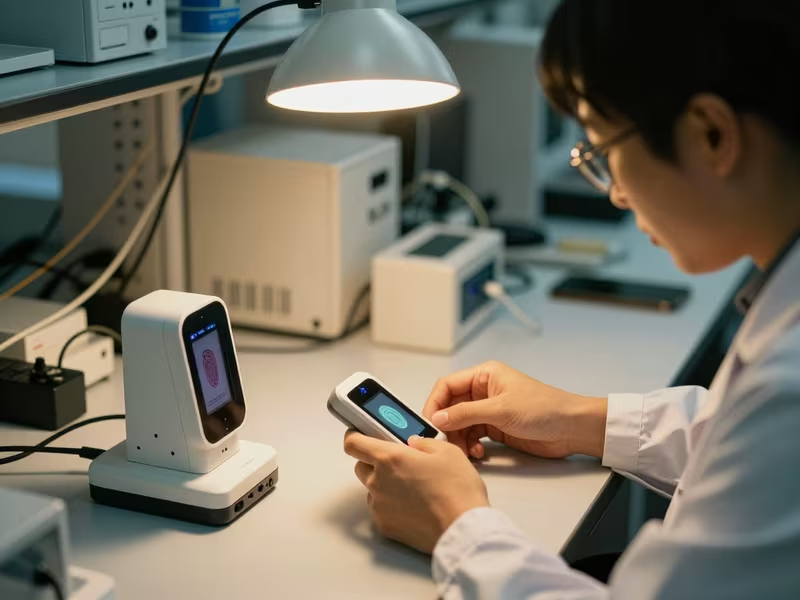
Biometric Security Systems
Multi-modal bioinformatic authentication fusing multiple independent identity signals for high-assurance, anti-spoofing, zero-trust security. INSTAR's Biometric Security Systems laboratory investigates the science of combining diverse biological identity markers so that no single compromised signal can defeat the system — delivering a fundamentally stronger assurance model for sensitive environments where identity certainty is not negotiable.
The Case for Multi-Modal Biometrics
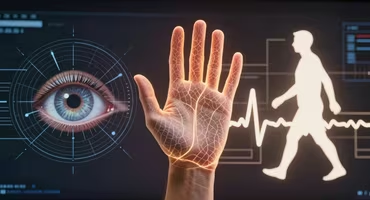
Single-factor biometric systems share a fundamental weakness: if an adversary can replicate or spoof that one signal, the authentication collapses entirely. Multi-modal fusion changes the security model by requiring simultaneous, coherent presentation across several independent identity channels — genomic markers, behavioral and gait signatures, vascular patterns, and others — each of which carries its own assurance and its own distinct spoofing challenge.
The combination is not merely additive. INSTAR's research investigates how independent signals interact to produce an authentication assurance that exceeds what any individual modality could provide, while building in natural presentation-attack resistance: a system that demands biological coherence across all channels is fundamentally harder to deceive than any single-signal approach, regardless of how sophisticated the attack on any one channel becomes.
High Assurance on Commodity Hardware
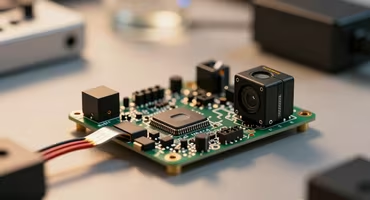
Frontier identity science should not require frontier hardware budgets. A core objective of this research program is ensuring that high-assurance multi-modal authentication can operate on the kinds of sensors and compute platforms that organizations can realistically deploy at scale — not just in bespoke laboratory rigs.
This research is commercialized through INSTAR's partner Viper Dynamics, who develop and own the resulting identity products. INSTAR's role is the underlying science; Viper Dynamics independently engineers, manufactures, and brings to market the identity security platforms built on this research foundation. Organizations seeking deployed solutions should engage Viper Dynamics directly.
Zero-Trust Security for Sensitive Environments
Zero-trust security architecture assumes no identity claim is inherently trustworthy — every access request must be continuously verified, at every boundary, with evidence rather than assumption. Multi-modal biometric systems are a natural fit for this model: they can provide continuous, passive re-authentication that does not interrupt the user while maintaining a verifiable, real-time identity posture throughout a session.
INSTAR investigates how biometric identity science integrates with zero-trust network and access architectures in environments where the stakes of an impersonation are highest — secure facilities, critical infrastructure operations, classified computing environments, and high-value financial systems. The goal is a security posture that is rigorous without creating operational friction that users route around.
Grounded in Open Data
Responsible biometric research requires transparent, publicly verifiable datasets and standards. INSTAR draws on authoritative open sources to benchmark authentication algorithms, validate spoofing-resistance techniques, and ensure our methods meet or exceed government-recognized standards before any research is transitioned to commercial partners.
- NIST (National Institute of Standards and Technology) — biometric evaluation frameworks, FRVT testing data, and identity verification standards that inform our algorithm benchmarking.
- data.gov — U.S. federal open data repository; used to access public identity and security research datasets for baseline evaluation.
- DHS (Department of Homeland Security) — identity verification guidance and biometric policy standards for high-assurance security contexts including border protection and critical infrastructure.
OUR PARTNERS






For Researchers
Join the INSTAR Fellowship
The INSTAR Fellowship is an open citizen-scientist program — no minimum degree required, selection based on fit with our research culture. Structured mentorship, interdisciplinary scope, and the freedom to pursue hard problems.